
November 23, 2026
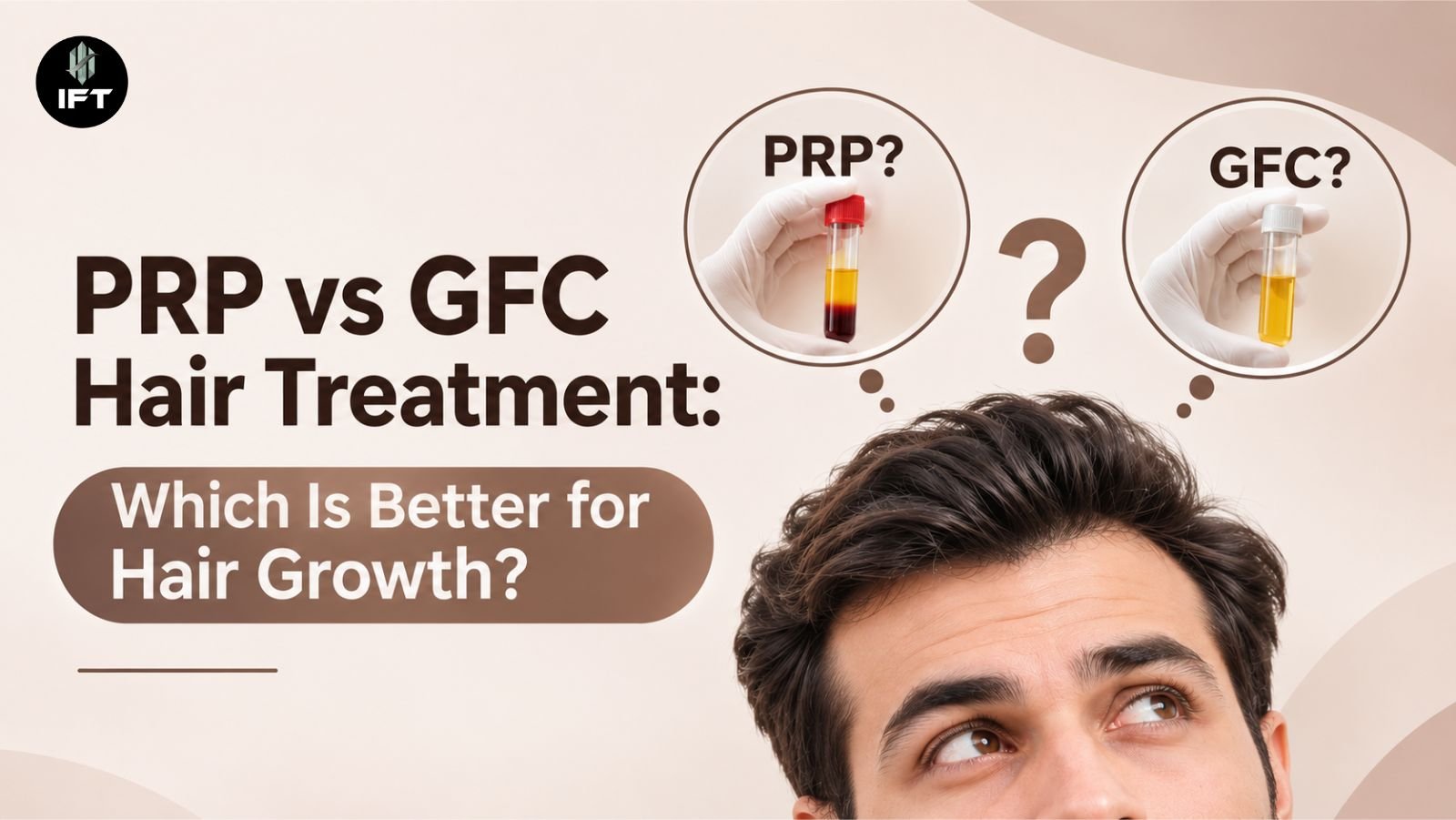
PRP vs GFC Hair Treatment: Which Is Better for Hair Growth?
Hair fall increasing despite trying different shampoos, oils and hair products? What if the solution is not another product but a treatment that works with your body’s natural growth factors?
PRP and GFC are two popular non-surgical hair restoration treatments that have gained attention among people experiencing hair thinning, excessive hair fall and reduced hair density. Both treatments use components derived from the patient’s own blood, but their preparation methods and approaches are different.
So, which one should you choose: PRP or GFC? Is the newer treatment always better, or does the right choice depend on your hair condition? Let’s understand the differences before making a decision.
What Is PRP Hair Treatment and How Does It Work?
PRP stands for Platelet-Rich Plasma. It is a non-surgical hair treatment that uses a concentrated portion of the patient’s own blood.
During the procedure, a small blood sample is collected and processed in a centrifuge to separate platelet-rich plasma. This plasma contains platelets that release growth factors involved in the body’s natural repair and regeneration processes.
The prepared PRP is then injected into selected areas of the scalp. These growth factors may help support weakened hair follicles, improve hair density and reduce hair shedding in suitable patients.
Potential Benefits of PRP:
- May help reduce excessive hair shedding.
- Supports the activity of existing hair follicles.
- May improve hair density in suitable patients.
- Uses biological material obtained from the patient’s own blood.
- Offers a non-surgical approach to managing hair thinning.
What Is GFC Hair Treatment?
GFC stands for Growth Factor Concentrate. It is another non-surgical hair restoration treatment that uses a patient’s own blood to prepare a concentrated growth-factor solution.
Unlike standard PRP, GFC uses a specialized preparation process designed to isolate and concentrate platelet-derived growth factors. The resulting preparation is injected into selected areas of the scalp to support weakened hair follicles.
GFC is often considered by individuals experiencing pattern hair loss and reduced hair density who are looking for non-surgical treatment options.
Potential Benefits of GFC:
- Delivers concentrated platelet-derived growth factors.
- May support weakened hair follicles.
- Can be considered for different patterns of hair thinning.
- Does not require hair transplant surgery.
- Provides another option for patients exploring regenerative hair treatments.
However, results depend on individual scalp conditions, follicle health and treatment protocols.
PRP vs GFC: What Are the Main Differences?
Although both treatments use the patient’s own blood, their preparation methods differ.
Comparison | PRP Treatment | GFC Treatment |
Full Form | Platelet-Rich Plasma | Growth Factor Concentrate |
Source | Patient’s own blood | Patient’s own blood |
Preparation | Platelet-rich plasma separation | Specialized growth-factor concentration |
Main Focus | Delivering platelet-rich plasma | Delivering concentrated growth factors |
Procedure | Scalp injections | Scalp injections |
Recovery | Generally minimal downtime | Generally minimal downtime |
Results | Vary by individual | Vary by individual |
Both treatments aim to support existing hair follicles, but neither guarantees hair regrowth.
PRP or GFC: Which One Is Better for Hair Growth?
This is the question most people want answered. The truth is that neither PRP nor GFC is universally better for everyone.
PRP may be suitable for individuals experiencing early-stage or moderate pattern hair loss. GFC may be considered when a specialized growth-factor concentrate approach is appropriate for the patient’s condition.
Some clinical research suggests that GFC may offer advantages in certain hair-growth measurements, while PRP also has research supporting its use. However, direct comparative evidence remains limited, and more high-quality studies are needed.
The right treatment depends on factors such as:
- The cause and stage of hair loss.
- Existing hair follicle condition.
- Scalp health and hair density.
- Medical history.
- Individual treatment goals.
A professional scalp assessment is therefore more important than simply choosing the treatment that sounds more advanced.
Why Choose IFT Hair Science for PRP and GFC Hair Treatment?
When it comes to hair restoration, choosing the right clinic is just as important as choosing the treatment.
At IFT Hair Science, patients can explore both PRP and GFC hair treatments based on their individual hair loss patterns, scalp conditions and restoration goals.
IFT focuses on personalized treatment planning rather than recommending the same procedure to everyone. The medical team evaluates the patient’s requirements and helps determine whether PRP, GFC or another hair restoration approach may be more suitable.
With over 13 years of experience, more than 18,000 satisfied patients, experienced hair restoration professionals and specialized treatment options, IFT Hair Science aims to make every treatment journey more informed and personalized.
Whether you are dealing with excessive hair fall, thinning hair or reduced scalp density, IFT Hair Science offers professional guidance to help you understand your available treatment options.
Don’t choose a hair treatment just because it is trending. Choose the right approach for your hair. With IFT Hair Science, take an informed step towards healthier-looking, stronger and fuller hair.
Frequently Asked Questions (FAQs)
- Is PRP or GFC better for hair growth?
Both PRP and GFC are non-surgical hair treatments that use growth factors derived from the patient’s own blood. GFC focuses on a concentrated growth-factor preparation, while PRP uses platelet-rich plasma. The better option depends on your hair loss condition, scalp health and medical assessment.
- How many PRP or GFC sessions are required for hair growth?
The number of sessions varies from person to person. It depends on the severity of hair loss, follicle condition and individual response to treatment. A hair restoration specialist can recommend a suitable treatment schedule after examining your scalp.
- Are PRP and GFC hair treatments safe?
Both treatments use material obtained from the patient’s own blood and are generally considered well-tolerated when performed by qualified medical professionals under appropriate clinical conditions. Temporary redness, swelling, tenderness or discomfort may occur after injections.
- How long does it take to see results from PRP or GFC treatment?
Hair growth takes time, so results are not immediate. Some patients may notice changes in hair shedding or density over several months. Results vary depending on individual conditions, treatment protocols and follicle health.
- Can PRP or GFC treatment regrow hair in completely bald areas?
PRP and GFC are primarily intended to support existing or weakened hair follicles. They generally cannot restore hair in completely bald areas where follicles are no longer functional. Depending on the condition, a hair transplant or another treatment may be more appropriate. A professional scalp assessment can help determine the right option.